 Airgap
Download
Airgap
Download
Product tour
Meet Airgap.
Eight screens from the app, with the controls that matter marked. Indexing, retrieval, and generation all run on the workstation. The only network access the app takes on its own is the one-time model download; everything beyond that is a switch somebody has to throw.
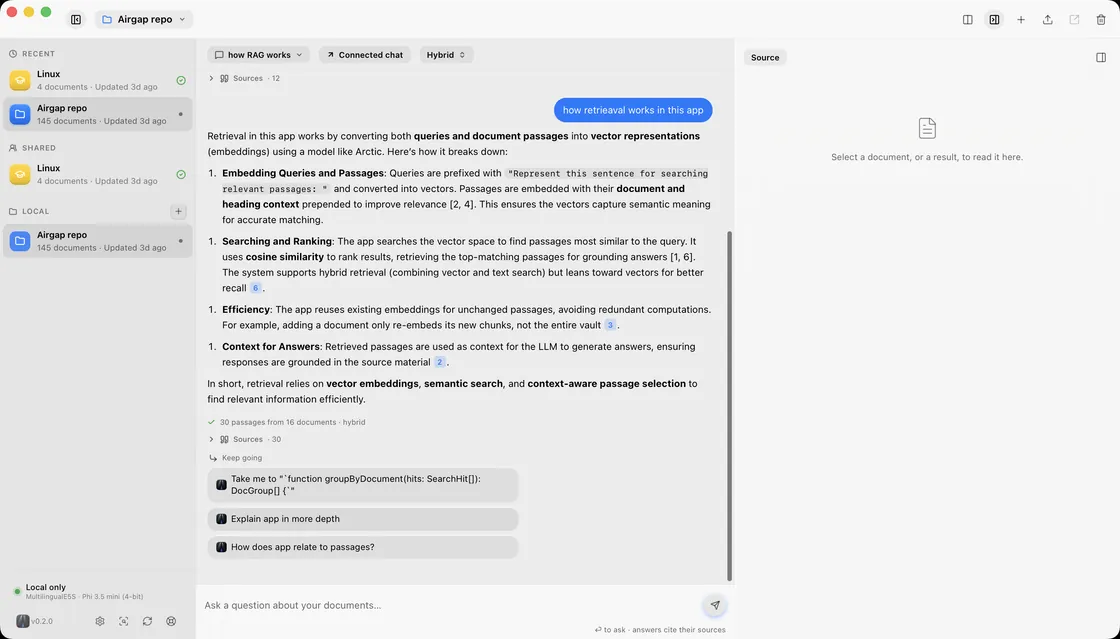
Grounded retrieval
Answers built from the passages your own corpus supplies.
Every question runs a retrieval pass first, and the model writes from the passages it returns. Hybrid mode blends cosine similarity over 384-dimension embeddings with BM25 full-text ranking; vector-only and full-text-only are there as well, chosen per thread.
- Connected chat, which sends the question and its passages to a hosted model. Dormant until someone starts one.
- Retrieval mode per thread: hybrid, vector, or full text.
- How many passages the answer used, from how many documents, and under which mode.
- Follow-up questions proposed by the model, or assembled from the citations when no model is installed.
Auditability
Every answer carries the evidence it was built from.
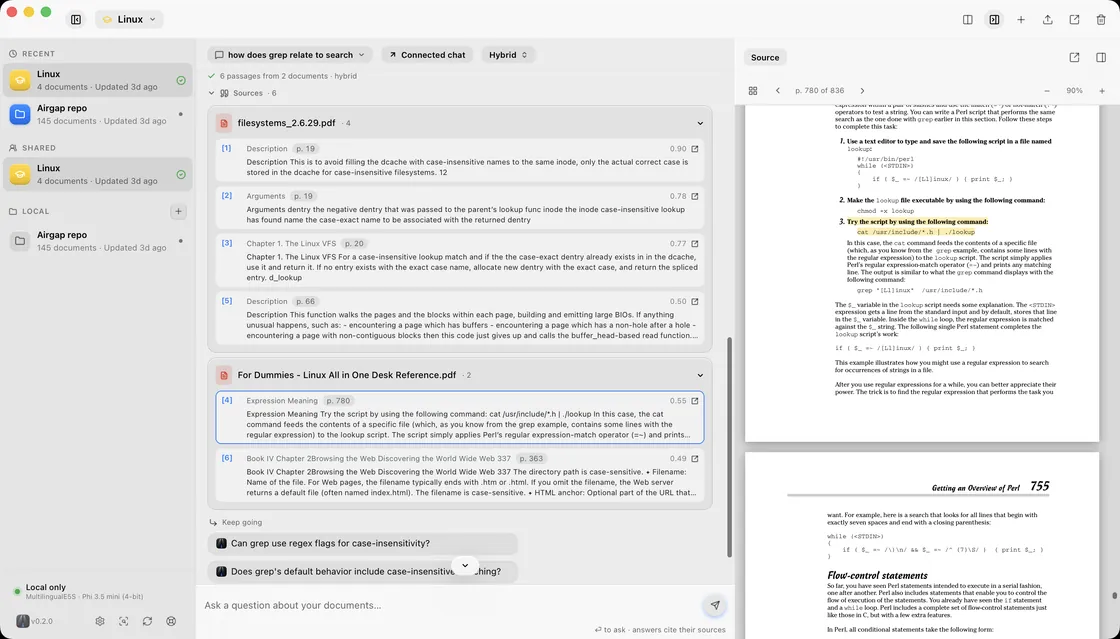
The sources drawer enumerates each passage behind a response, grouped by the document it came from, with its section, its page, and its retrieval score. A reviewer can check any claim against the passage that produced it without leaving the application.
- Grouped by source document, with the passage count for each.
- Section, page, and retrieval score on every passage.
- Passages from a second document, ranked in the same list.
Provenance
Citations open the page they were taken from.
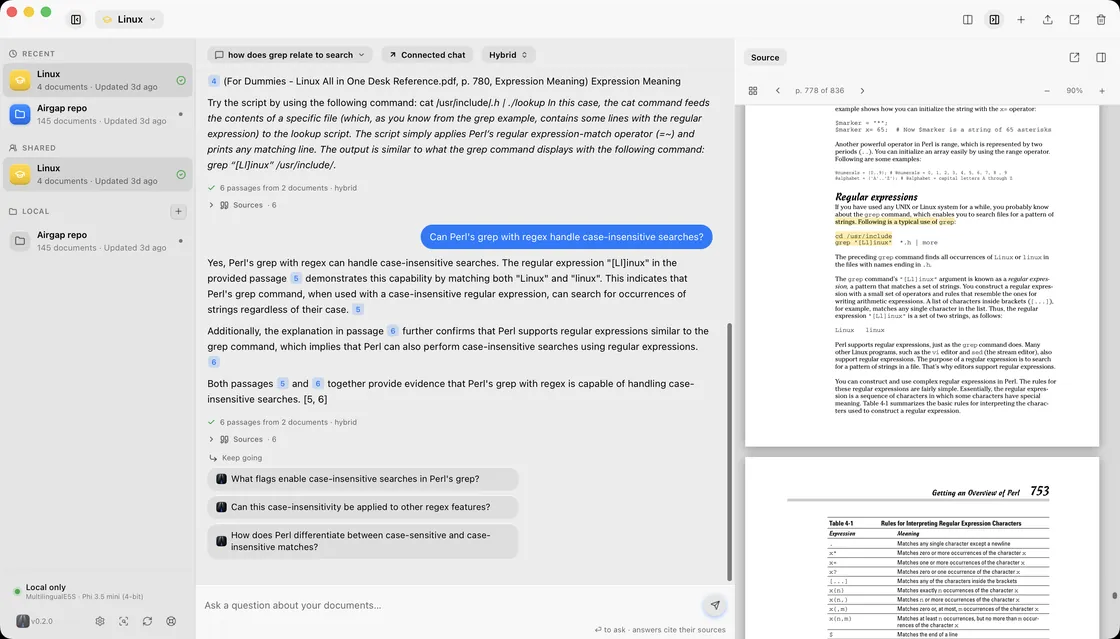
Each [n] marker in an answer is a button onto the passage behind it. Following one opens the original PDF at the cited page and marks the passage inside it. The viewer locates that passage in the rendered text at the moment you look at it, and works outwards through neighbouring pages when a passage straddles a page break.
- Citation markers in the answer, each one a button onto the passage it stands for.
- The cited line, marked in the source PDF on the page it sits on.
- Page 778 of 836, paged and zoomable in place.
Repository knowledge
The reasoning behind a codebase, indexed and answerable.
A repository’s markdown, commit messages, and doc comments convert into a corpus that indexes as an ordinary vault, rebuilt on merge. Architectural decisions and postmortems become searchable with the file each answer came from cited. Measured over 594 passages from this application’s own repository, a question phrased in the repository’s vocabulary put the right passage first six times in ten, and in the top ten every time.
- The file each indexed passage was derived from.
- The matched passage, marked where it sits in the document.
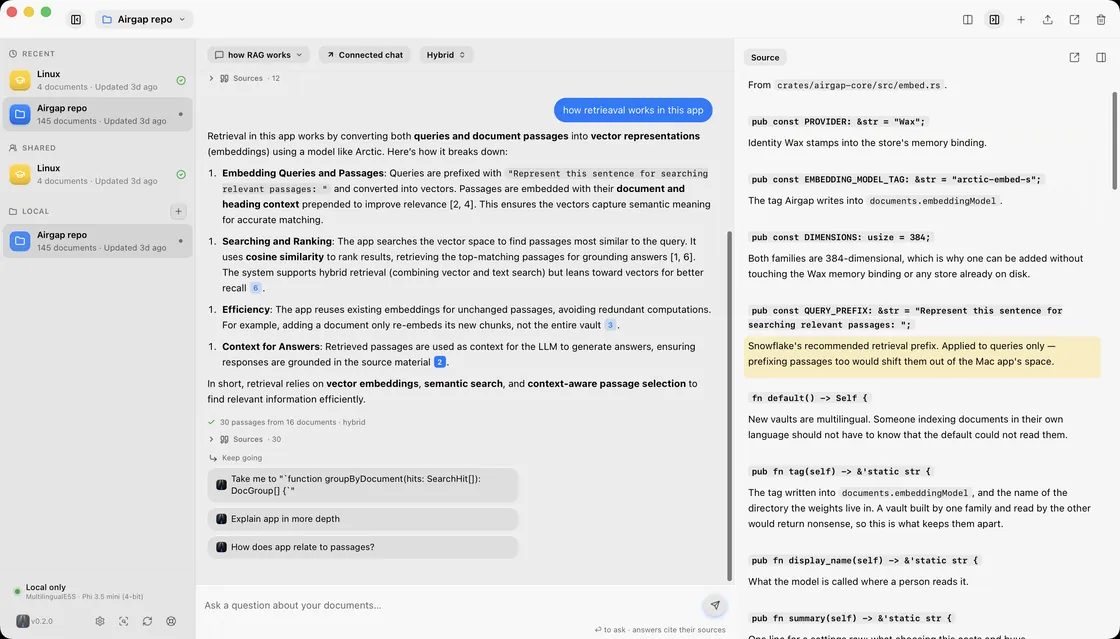
Output policy
House style and language, set once for a vault.
A standing instruction on a vault — an output language, a level of detail, a required form of reference — is added to every question asked in a connected chat. It applies after the citation rules and cannot displace them. Local models run at 1–4B parameters and four bits, and hold one instruction at a time, so airgap-mode answers leave it out by design and the sheet says so.
- One instruction, added to every connected question put to this vault. 2,000 characters.
- Presets to start from, or wording of your own.
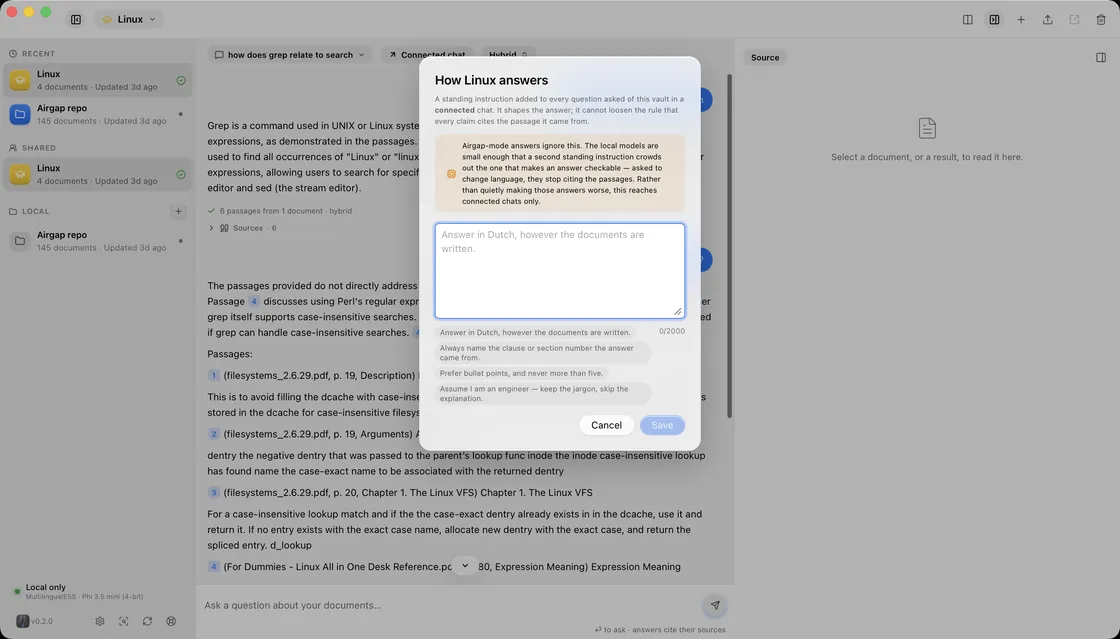
Distribution
Distribute a corpus through a folder the organization already runs.
Publishing writes the documents, a vector pack for each of them, and one immutable file per operation into a plain directory — OneDrive, SharePoint, Drive, Dropbox, an SMB share, Syncthing, a USB disk. Airgap opens no sockets for this and knows nothing about the provider. Membership and revocation stay with the folder, which is why there is no account system and no server to run.
- Vectors travel with the documents, so a subscriber rebuilds its own index and embeds nothing twice.
- Airgap still opens no network connection of its own here. It reads and writes a directory on this machine.
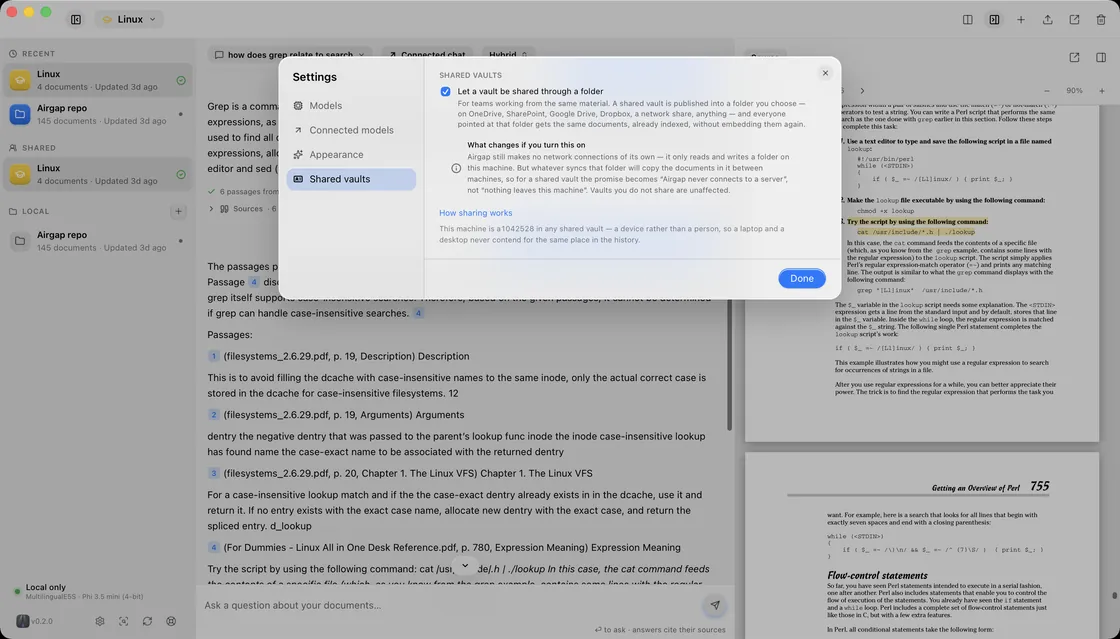
Interoperability
Vault search exposed to the tools your teams already work in.
Airgap serves MCP over Streamable HTTP on 127.0.0.1 with five vault-scoped tools: vaults_list, documents_list, vault_search, rag_query and vault_remember. Every request carries a bearer token. The surface stops there: no shell, no process spawning, no arbitrary filesystem read.
- Bound to loopback, and checked in the test suite against answering on any other interface.
- A vault stays invisible until it is ticked. Letting a client write to one is a second tick.
- Client configuration ready to paste, with a token that can be reissued.
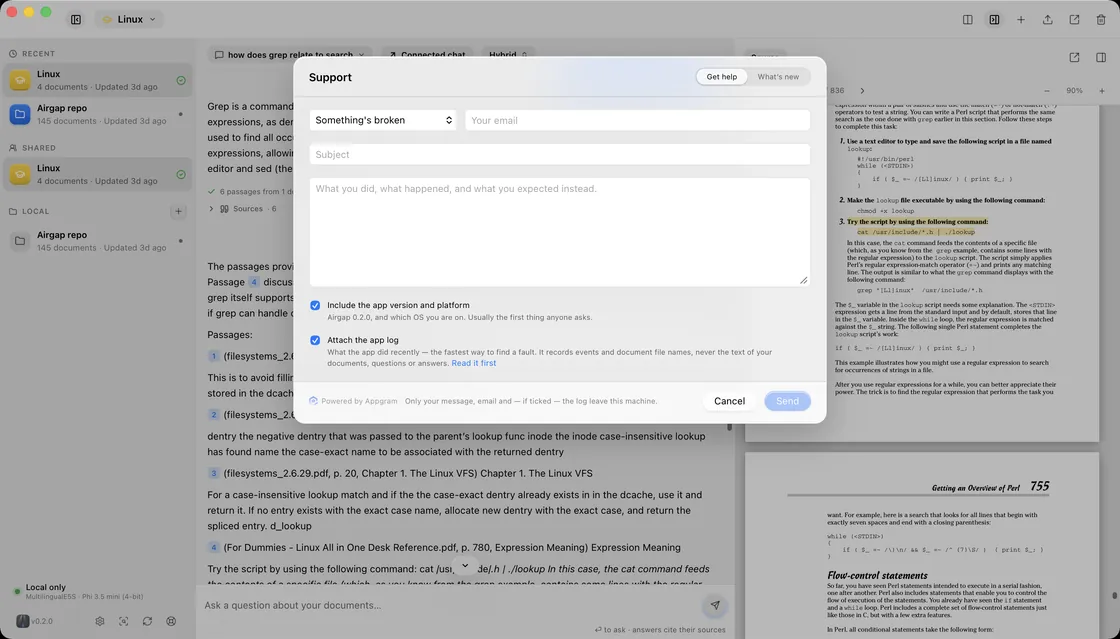
Diagnostics
A fault report you can read before you send it.
A report carries your message, your address, and — when selected — the application event log: operations performed and document file names. The text of your documents, your questions, and the answers is never written into it, and the log opens in the panel for review before anything is sent.
- Version and platform, and an event log of operations and file names.
- Only the items you tick leave this machine.
Next — in development
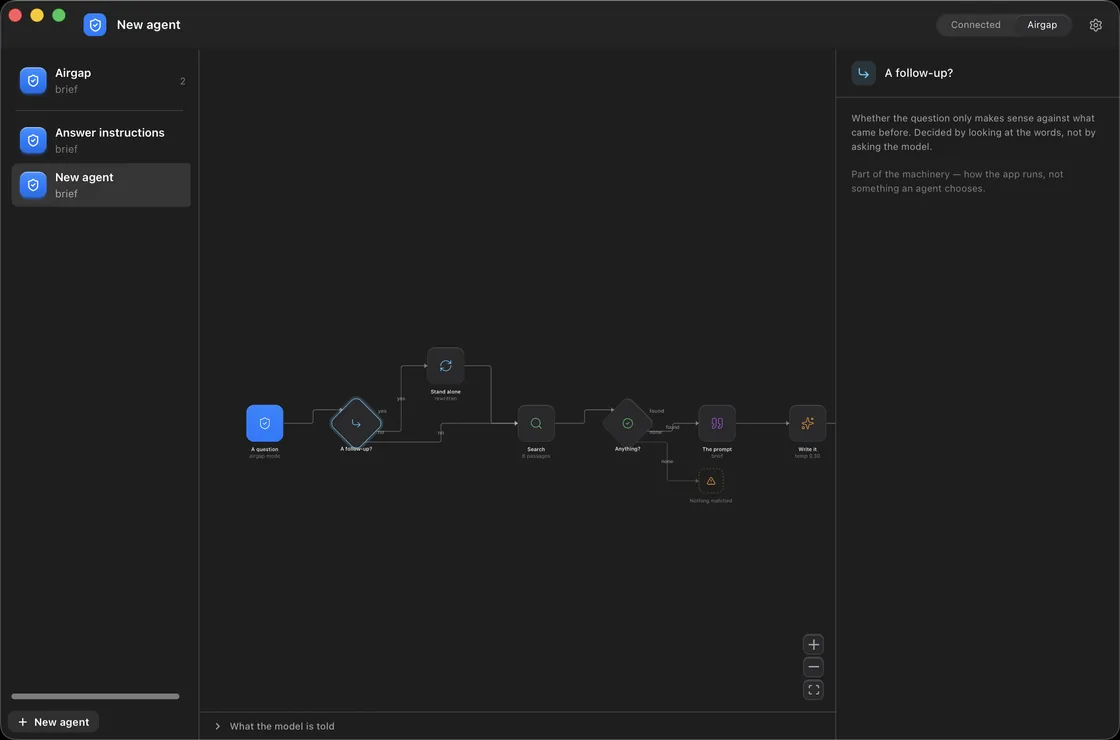
Agents for a vault, drawn on the pipeline the app already runs.
Not in the shipped build. An agent belongs to a vault, and it is drawn as the branching graph an answer actually takes: is this a follow-up, rewrite it so it can be retrieved on its own, search, is there anything, build the prompt, write it. Connected and airgap are drawn as two different graphs, because they are — a connected chat runs a tool loop that searches, reads, and searches again in different words, and a local one is handed its passages before it ever reads the question.
- One agent per job, kept with the vault it answers for.
- The pipeline as it runs, branch for branch.
- Each step says what it does, and whether an agent can set it at all.
- The prompt in full. The citation rules inside it stay out of an agent’s reach.
Evaluate it on your own documents.
The same application on macOS, Windows, and Linux, with no account to create and nothing to provision. Point it at a folder, wait for the index, and put your own material to it. Update checks are opt-in and off by default.